
Models
HANNA
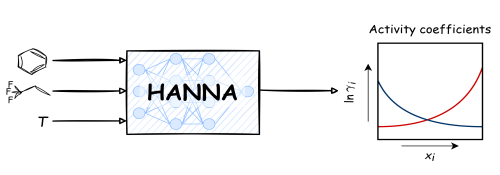
HANNA is a hard-constraint neural network model for the excess Gibbs energy
Two versions of the model are available:
ogHANNA: The original version (HANNA v1.0.0), trained on binary VLE data (up to 10 bar) and limiting activity coefficients from the Dortmund Data Bank [1]. This version is limited to binary mixtures.HANNA(aliasmultHANNA): The latest version, trained on VLE and LLE data, and applicable to multi-component mixtures [2].
MLThermoProperties.ogHANNA Type
ogHANNA <: ActivityModel

ogHANNA(components;
puremodel = nothing,
userlocations = String[],
pure_userlocations = String[],
verbose = false,
reference_state = nothing)
Input parameters
SMILES: canonical SMILES (using RDKit) representation of the componentsMw: Single Parameter (Float64) (Optional) - Molecular Weight[g·mol⁻¹]
Input models
puremodel: model to calculate pure pressure-dependent properties
Description
Hard-Constraint Neural Network for Consistent Activity Coefficient Prediction (HANNA v1.0.0). The implementation is based on this Github repository. ogHANNA was trained on all available binary VLE data (up to 10 bar) and limiting activity coefficients from the Dortmund Data Bank. ogHANNA was only developed for binary mixtures. Use HANNA for multicomponent mixtures.
Example
using MLThermoProperties, Clapeyron

components = ["water","isobutanol"]
Mw = [18.01528, 74.1216]
smiles = ["O", "CC(C)CO"]

model = ogHANNA(components,userlocations=(;Mw=Mw, SMILWS=smiles))
# model = ogHANNA(components) # also works if components are in the database
References
- Specht, T., Nagda, M., Fellenz, S., Mandt, S., Hasse, H., Jirasek, F., HANNA: Hard-Constraint Neural Network for Consistent Activity Coefficient Prediction. Chemical Science 2024. 10.1039/D4SC05115G.
MLThermoProperties.multHANNA Type
HANNA <: ActivityModel
multHANNA

HANNA(components;
puremodel = nothing,
userlocations = String[],
pure_userlocations = String[],
verbose = false,
reference_state = nothing)
Input parameters
SMILES: canonical SMILES (using RDKit) representation of the componentsMw: Single Parameter (Float64) (Optional) - Molecular Weight[g·mol⁻¹]
Input models
puremodel: model to calculate pure component properties
Description
Hard-Constraint Neural Network for Consistent Activity Coefficient Prediction (HANNA). HANNA was trained on all available binary VLE data (up to 10 bar) and limiting activity coefficients from the Dortmund Data Bank.
Example
using MLThermoProperties, Clapeyron

components = ["dmso", "ethanol", "aspirin"]
Mw = [78.13, 46.068, 180.158]
smiles = ["CS(=O)C", "CCO", "CC(=O)Oc1ccccc1C(=O)O"]

model = HANNA(components,userlocations=(;Mw=Mw, SMILES=smiles))
# model = HANNA(components) # also works if components are in the database
References
- M. Hoffmann, T. Specht, Q. Göttl, J. Burger, S. Mandt, H. Hasse, and F. Jirasek: A Machine-Learned Expression for the Excess Gibbs Energy, (2025), DOI: https://doi.org/10.48550/arXiv.2509.06484.
mod. UNIFAC 2.0 and UNIFAC 2.0
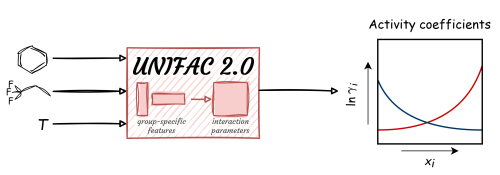
UNIFAC 2.0 and mod. UNIFAC 2.0 are enhanced versions of the classical group-contribution methods UNIFAC and mod. UNIFAC (Dortmund), respectively. Missing interaction parameters are predicted using matrix completion, which significantly extends the applicability of the methods and leads to a higher prediction accuracy compared to the original versions [3, 4]. The methods for UNIFAC 2.0 and mod. UNIFAC 2.0 are described in the Clapeyron.jl documentation.
GRAPPA
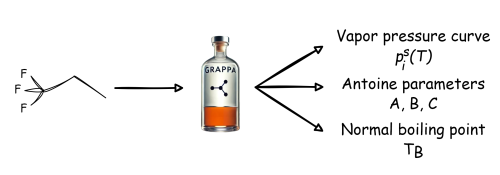
GRAPPA is a graph neural network model for predicting vapor pressures and boiling points of pure components [5]. The model predicts the parameters
On model construction, the Antoine parameters are predicted and a SaturationModel is automatically created, which enables the calculation of the vapor pressure via saturation_pressure for a given temperature.
MLThermoProperties.GRAPPA Type
GRAPPA{T} <: SaturationModel

GRAPPA(
    components;
    userlocations = String[],
    verbose::Bool=false
)
Description
GRAPPA model for calculating vapor pressure of pure components based on the Antoine equation. On model construction, the Antoine parameters are predicted using a Python implementation the GRAPPA model.
Requires loading the package PythonCall.jl
GRAPPA uses a modified Python implementation taken from https://github.com/marco-hoffmann/GRAPPA. Therefore to use the GRAPPA model, you need to install and load the package PythonCall.jl by
using Pkg; Pkg.add("PythonCall")    # Installation
using PythonCall                    # Loading
For predicting the Antoine parameters, only the smiles of the molecule is required. It will automatically be retrieved from the Clapeyron.jl database. The smiles can also be provided by the userlocations keyword (see example below).
Example
using Clapeyron, PythonCall

model = GRAPPA("propanol")
model = GRAPPA("propanol"; userlocations=(; smiles="CCCO"))

ps, _, _ = saturation_pressure(model, 300.)         # Vapor pressure at 300 K
References
- M. Hoffmann, H. Hasse, and F. Jirasek: GRAPPA—A Hybrid Graph Neural Network for Predicting Pure Component Vapor Pressures, Chemical Engineering Journal Advances 22 (2025) 100750, DOI: https://doi.org/10.1016/j.ceja.2025.100750.
ESE
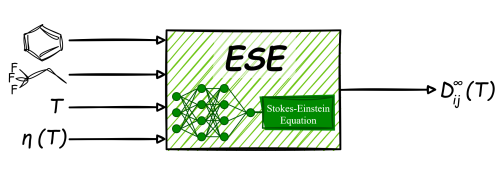
ESE is a hybrid model for predicting binary diffusion coefficients at infinite dilution [6]. The model incorporates the Stokes-Einstein equation and ensures a physically consistent temperature dependence of the predicted diffusion coefficients. It only requires the SMILES of the solute and solvent as input, together with a viscosity model for the solvent.
MLThermoProperties.ESE Type
ESE <: AbstractTransportPropertyModel

ESE(components;
vismodel = nothing,
userlocations = String[],
vis_userlocations = String[],
verbose = false)
Input parameters
SMILES: canonical SMILES (using RDKit) representation of the componentsMw: single parameter (Float64) (Optional) - Molecular Weight[g·mol⁻¹]vismodel: viscosity model
Description
ESE model for calculating diffusion coefficients at infinite dilution. The diffusion coefficient at infinite dilution can be calculated by calling inf_diffusion_coefficient.
If no viscosity model is specified, a GCESModel from EntropyScaling.jl is constructed (if possible). A constant viscosity model can also be used if the viscosity η is knwon as ESE(...; vismodel=ConstantModel(Viscosity(), η)).
Examples
using MLThermoProperties, EntropyScaling

model = ESE(["ethanol", "acetonitrile"])
D_matrix = inf_diffusion_coefficient(model, 1e5, 300.)
D_eth = inf_diffusion_coefficient(model, 1e5, 300.; solute="ethanol", solvent="acetonitril")